
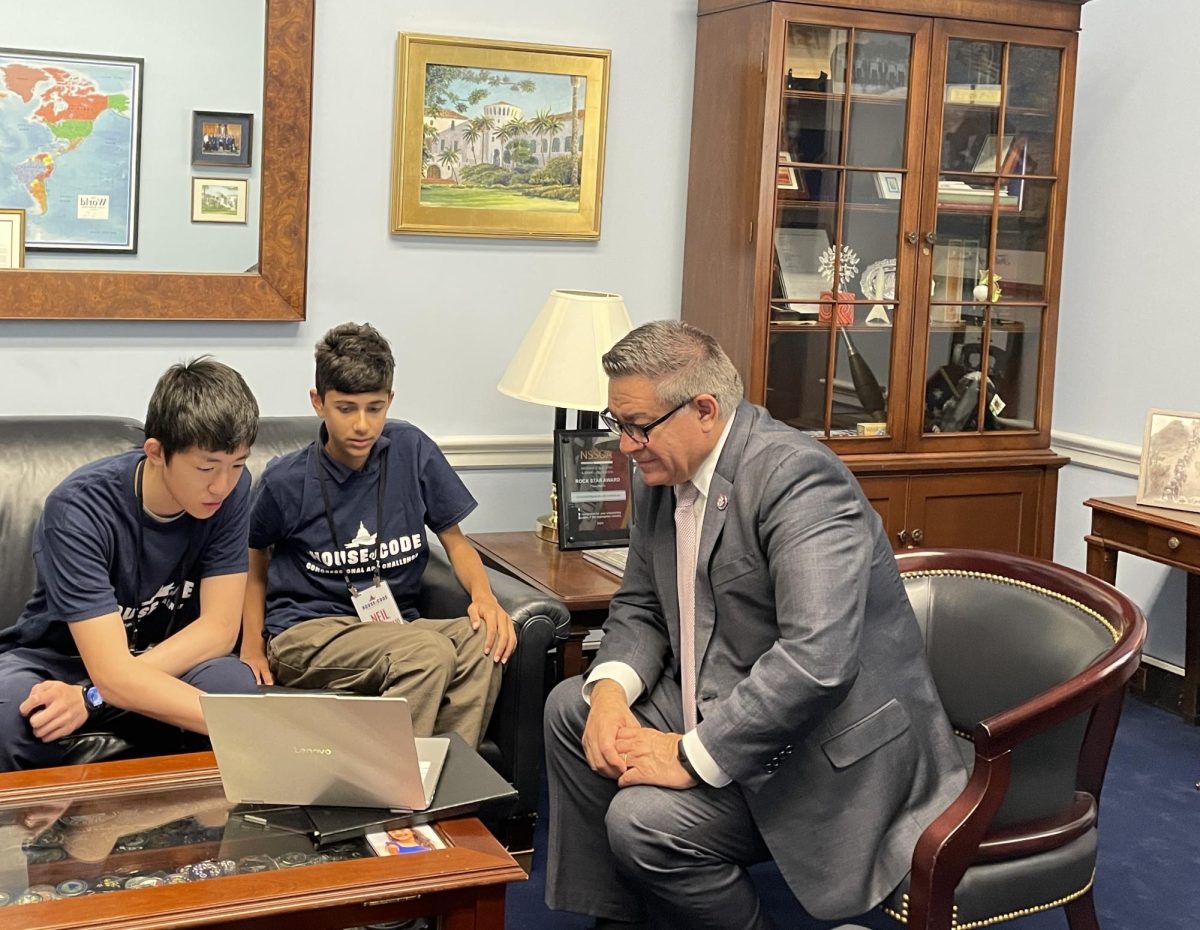
Dos Pueblos High School students Ethan Ding (11) and Neil Sharangpani (11) were invited to Washington, D.C. after winning the Congressional App Challenge for California’s 24th District. Ding and Sharangpani submitted their entry last October and heard back in December. From April 21-22, 2026 they will travel to Washington D.C. to take part in the ceremony, House Of Code, where they will receive their award, present their app, and connect with other winners.
“The Congressional App Challenge is a government-run coding competition,” Ding said. “You can … submit an app that you made, and this app should solve a problem in the world.”
Entries are submitted to district-wide competitions, and members of Congress select the winners in their respective districts.
“Every year, the representatives for each district select apps submitted by students across the district,” Sharangpani said. “[They] choose one to represent each district in D.C. for the House of Code event.”
For their entry, Ding and Sharangpani created an app called Eulearn. It is an integral solver designed to aid students taking calculus classes. The app includes a solver, practice problems, and review materials for key techniques. Ding said that integrals are “difficult” but “essential” for high-level math and careers in STEM. Through the app, Ding aims to create more proficiency in calculus.
“[Eulearn is] an integral solver that mimics the reasoning of a human tutor,” Ding said. “We realized that a lot of online tools had really robotic reasoning that didn’t make sense to high school students.”
Most websites are composed of two parts: a front end that displays what viewers see, and a back end where the site’s information is stored. Though Ding had a “slight background” in coding, Eulearn allowed him to brush up on his previous skills and learn new ones, since the app used a variety of different coding languages.
“For the front end, we used HTML, CSS, [and] JavaScript,” Ding said. “For the back end, we used Python because there are some Python libraries, especially one called SciPy, which we used to do symbolic math.”
Neither Ding nor Sharangpani said they expected Eulearn to win, because it was up against over 50 apps, but they were motivated by the win.
“[Around late December] we received a call from Congressman [Salud] Carbajal,” Sharangpani said. ”I was really shocked … I couldn’t even process it at first. It is a great honor to represent California’s 24th District.”
Sharangpani said that he and Ding will continue to improve their app and attract more users.
“While we are in D.C. we’re going to work on it extensively and try to refine it,” Sharangpani said. “Even after the House of Code were definitely going to keep improving it to get as many users as possible”
In addition to displaying their app, Ding and Sharangpani will be able to explore a variety of educational opportunities while in D.C.
“We’ll look at the winning apps,” Sharangpani said. “A few students are giving talks, we’ll just be demonstrating the app and meeting with other members of Congress.”
Winning the Congressional App Challenge has encouraged Sharangpani to continue with other coding projects.
“I was coding small projects from a young age,” Sharangpani said. “But I didn’t think it was even possible [for me] to code something of this scale. Now that I can do it, it opens the door to so many possibilities.”
Ding hopes that Eulearn’s win will encourage other students to enter the Congressional App Challenge.
“Compete not just for the award, but to actually solve a problem,” Ding said. “Because if you’re competing for the award … you might just get the award. But … The most important thing even if you don’t win is to create something that matters, and you are still able to use your app.”
Edited 4/23/26 photo update