
Society seems to take pride in waking up early and going to sleep late. People who live this way are often praised as “hardworking” and “high achievers,” which I believe glorifies an unhealthy process for little value. I prefer to call them birdmaxxers — people who are trying to be simultaneously an early bird and a night owl at the same time.
Daylight Saving Time (DST) began on March 8, 2026. From now until fall, our clocks will be set an hour ahead, and we gain the privilege of being able to birdmax to a higher extreme! Amazingly, students get to be woken up and hit by the crushing weight of existence an hour earlier than usual.
And it’s not even for one day. Oh, no. It’s going to be like this for the next six months.
The timing honestly couldn’t have been worse. The spring semester has only just begun at Dos Pueblos High School (DPHS), and many students are still getting used to the realisation that they must stay awake enough to take notes for another five months. But since DST began, many students feel an hour sleepier and an hour closer to death.
Over the past week, I’ve dutifully dragged myself away from sleep and through the motions of being “productive.” Although technically I’m upright and breathing, in reality, I’m so absurdly tired that I’m practically sleepwalking.
By the time I get home from school, the mellow afternoon sun is still slanting through my window shutters like I’m in a Febreeze advertisement. Contrary to the scenery, the day is apparently almost over, and it looks like my homework will drag into the late hours again.
There is no justification for pretending to be a bird when all DST is doing is creating exhausted students, deeper eye bags, and an increasingly caffeine-addicted population.
I’m not an ornithologist, but if humans are supposed to be birds, they’re doing a pretty poor job of it. Most real birds get to sing and fly fast and free, which is a liberty I’m pretty sure we don’t have.
What are legs for, if not for frolicking in the fields? What are voices for, if not for singing? Instead, at school, all I hear are complaints.
“I’m so sleepy, I can’t even think straight.”

“I don’t want to run the mile today, I’ve barely slept.”
“I’m so tired, I might die.”
As if all this isn’t already the worst tragedy since the Cracker Barrel logo redesign, DST has arrived to dump more salt in the wound.
People often shrug and say, “It is what it is” — but does it have to be this way at all?
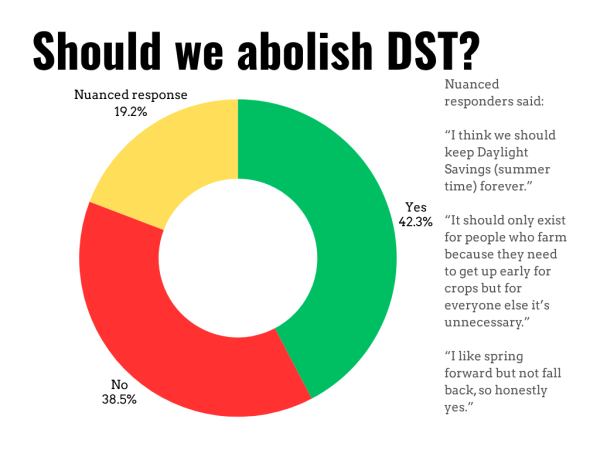
Many students clearly don’t think it should be. In a 2026 survey of 53 DPHS students, only 34% of students said that they like DST, whereas 42.3% of those surveyed said that they think it should be abolished, and 19.2% offered nuanced answers such as liking Standard Time (ST) but not DST or abolishing the time changes for everyone but farmers. The policy is hardly winning any popularity contests.
Many students agree that the shift in sunlight creates a disturbing effect on the day’s activities.
“I prefer it when the sun rises earlier. That way I can do stuff in the mornings,” Rebecca Cabeen (10) said. “With the extra long days … I feel like it makes it harder to see sunsets, in my opinion. So I don’t like Daylight Savings Time.”
The issue isn’t just inconvenience, either. Research suggests that the time change could have real health consequences. A 2025 study by Stanford Medicine found that shifting the times at which we receive light will negatively impact our circadian system. The researchers concluded that committing to a single time system, such as ST, which is employed at the “fall back” time change, will be more beneficial to our health than switching semi-annually. Such benefits include lowering cases of obesity by 2.6 million people and stroke by 300,000 people.
“I dislike Daylight Saving Time because the shift to it is really abrupt and it messes up my sleep schedule,” Cabeen said.
Supporters of DST often argue that it helps save energy by reducing the need for lighting, which used to be powered by means of coal and oil. However, we’re no longer trying to save coal and oil as the government did during World War I, when the policy was first introduced.
Modern-day technology has changed the game, providing us with relief from the hot summer sun by means of air conditioning. The longer we toast in the daylight, the more energy our cooling systems consume, which would neutralise the energy saved from lighting.
Additionally, DST also brings the inconvenience of changing every clock we own.
It’s incredibly infuriating to have to adjust every timekeeping device, and ironically, it ends up being time-consuming as well. Eventually, these costs in time convert to costs in money because “time is money,” as Benjamin Franklin said. Transportation industries such as airports and train stations face the most chaotic end of the adjustments — some countries do not observe the time changes, while others do.
“The way that we do [the time change] … we wake up, and it’s, ‘Now you’re late for school, have fun,’” Minnie Brenninkmeyer (10) said. “So I think that instead of having the big jump, we should have little jumps.”
The average student is somehow expected to stay diligent and keep up with the sheer number of timekeeping devices around them. Nowadays, it doesn’t just end at the analogue clock on the wall — there’s also the clock on the car dashboard, the microwave display, the oven door, and even the one on the rice cooker. For a species that seems so incredibly fond of talking about the scarcity of time, we sure like to waste it a whole lot on resetting clocks.
There has been growing support for sticking to just DST or ST permanently and eliminating time changes altogether.
In 2022, the Sunshine Protection Act was approved by the U.S. Senate, which, if approved by the House of Representatives, would have made DST permanent. Unfortunately, no such thing happened, and the bill died a sad and withering death.
Today, DST continues to haunt students as we move further into the spring semester, serving as a detriment to our health and productivity and increasing our unified exhaustion.
The time changes may have made sense back then, when humans relied on candlesticks and oil lamps for lighting. Now, I live in a world of smart fridges and air conditioning, and the time changes are no longer relevant.
We’re still sleep-deprived morons — but now we’re sleep-deprived morons with better technology.