
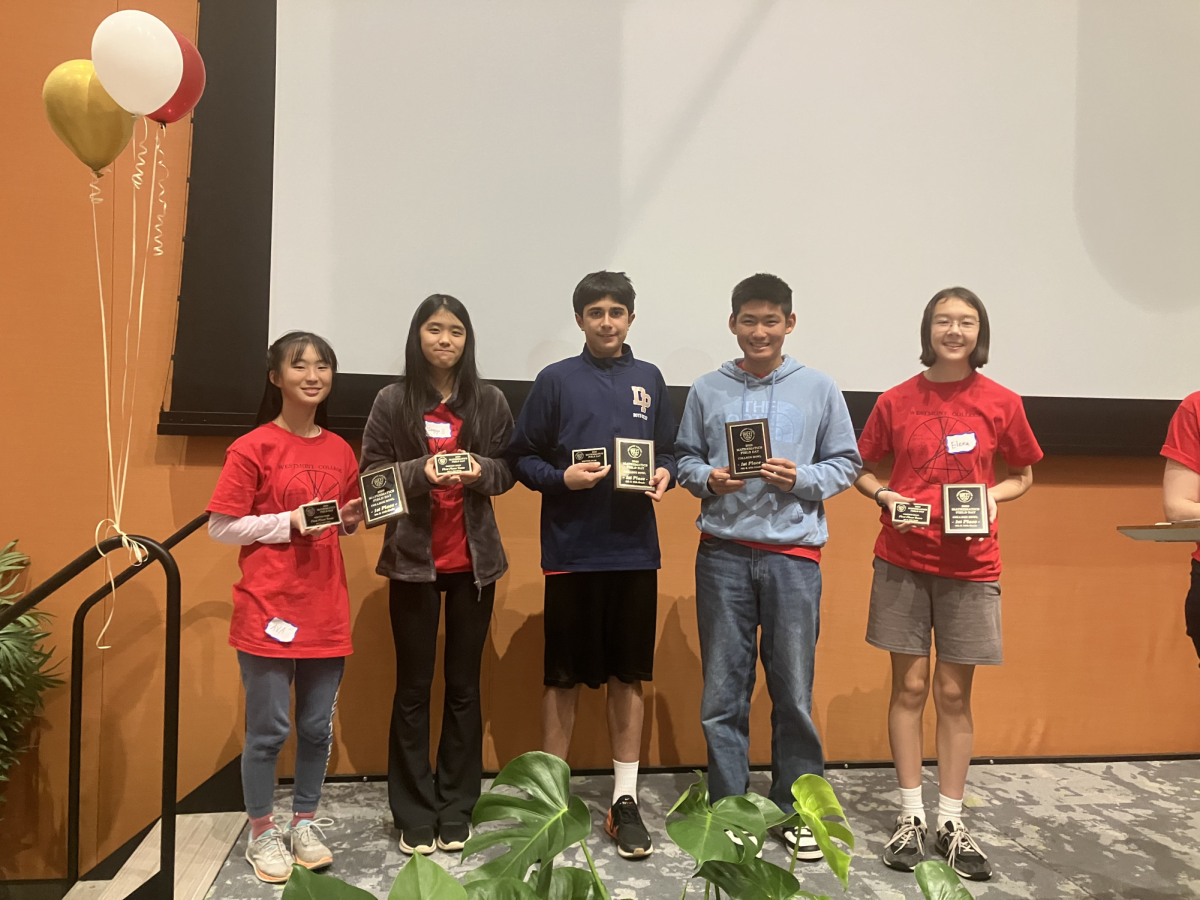
Five freshmen and sophomores from Dos Pueblos High School’s Math Club earned first place at the Westmont College Mathematics Field Day, beating Cate School in the finals with a score of 21-7. The competition, which took place on Saturday, Feb. 7., consisted of two rounds: a “College Bowl” buzzer round, and a free-response, collaborative “Team Exam.”
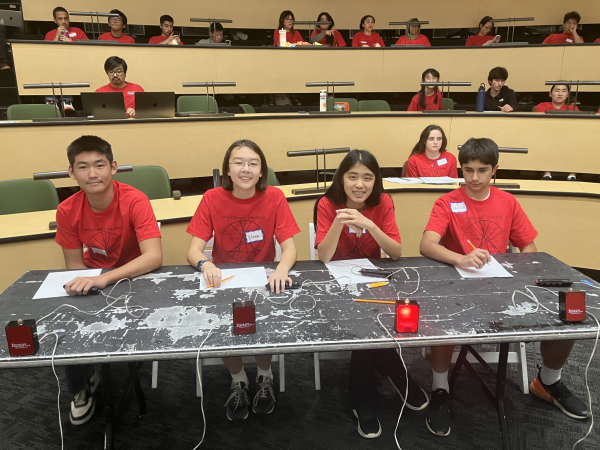
In the buzzer round, two opposing teams of four students each competed to answer questions as quickly and accurately as possible. The DPHS ninth-grade and tenth-grade buzzer team consisted of Elena Beckman (10), Seungyoo Kim-Jung (10), Shayan Sen-Mostofi (9), and Hansen Huang (10), who took turns competing.
Despite the intensity of the event, the team members said the structure of the competition helped them stay focused.
“I could be at the front of a stadium, with an entire crowd watching me,” Kim-Jung said. “And I’ll just be like, ‘Alright, what’s the next question?’”
Although several DPHS students reported initially feeling anxious prior to the competition, they were able to relax after talking to their teammates.
“At the start, I was really nervous. My hands were shaking a bit,” Huang said. “But afterwards, I calmed down after talking with other people. It helped me take my mind off how nervous I was, and I think my performance reflected that.”
During the buzzer round, the team dominated the math competition. The majority of the opposing teams were unable to score against them.
“It’s really big for the team,” Sen-Mostofi said. “We were able to bring something home, and we were able to have fun.”
Beckman, Kim-Jung, Sen-Mostofi, and Zhang also participated in the written exam: the round required each team to work together to solve a set of problems and submit detailed written proofs. The team placed first in this round as well, earning the DPHS team first place overall.
“When a team gets [an award], it’s really motivating for them to keep doing math, because they just got something out of working hard,” Kim-Jung said. “It’s really fulfilling to see that your skills pay off in places like these.”
The team was derived from the DPHS Math Club, which meets every Tuesday at lunch in H-26. During meetings, members listen to presentations on math concepts, discuss problem-solving strategies, and work through practice problems together.
“Maybe you don’t want to go to competitions, but you like math,” Sen-Mostofi said. “It’s just being there and being with a lot of people.”
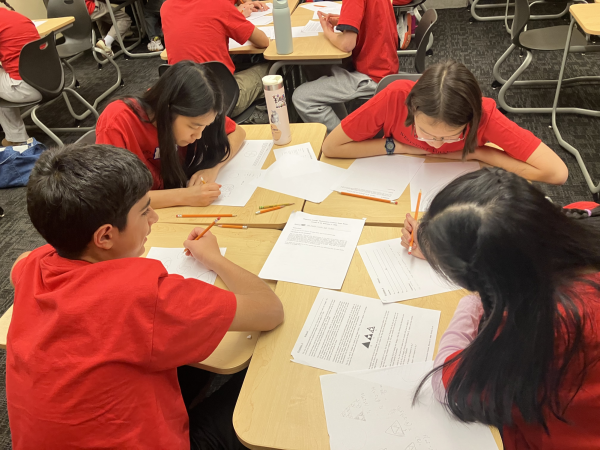
According to Beckman, collaboration and working together are a central focus of the club. The club members value their peers and emphasize the friendship they have been able to build with each other.
“I feel like the Math Club is sort of like my friend group,” Beckman said.
Club members said they often exchange advice with each other and practice accordingly. For example, Huang mentioned how he anticipated that the number 2026 might appear in the competition at Westmont.
“For a lot of math competitions, they like to shoehorn the year into it somehow,” Huang said. “So, I always make a note to memorize all the factors of the year. For this year, it’s 2026.”
Li Harper, the Math Club advisor, says that despite the challenges in math, problem-solving, and competitions, it’s good to “embrace the challenge.”
“It’s important to build your memories in high school,” Harper said. “Step out of your comfort zone. Take the risk. Just being able to be there, I think it takes a lot of courage.”
Math Club members said the lessons learned through math can often be applied beyond competitions.
“When you’re nervous, sometimes that helps you, but if you’re too nervous, your brain just goes blank, and you can’t think anymore,” Kim-Jung said. “So it’s important to have a balance between nerves and relaxation.”
Huang attributes his ability to grow from challenges from both his experience with the Math Club and from lessons he learned outside of school.
“I learned that it’s good to make mistakes. If we don’t make mistakes, then we can’t learn from them,” Huang said. “And if we can’t learn from them, we’ll never be able to actually do anything. My dad taught me that lesson a long time ago, and it really stuck with me.”
Math Club President Aaron Xie (12) also competed at the event, earning third place in the Chalk Talk for a presentation on factoring polynomials over finite fields and prime numbers.
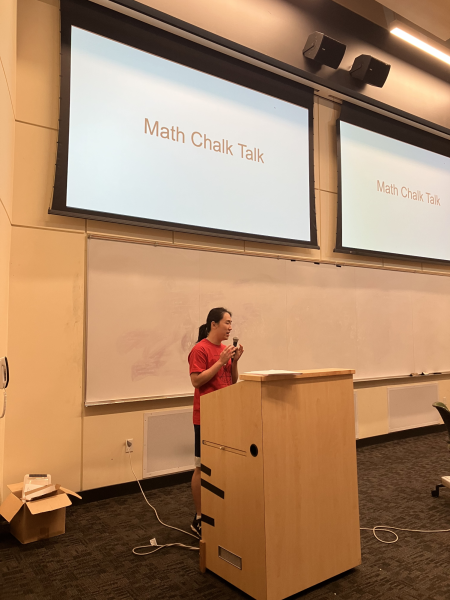
Xie structured his Chalk Talk “like a journey,” narrating the learning journey from factoring to prime numbers to polynomials, and finally, how those steps led to the questions that guided his Chalk Talk.
“To be a mathematician is to be critical about everything,” Xie said. “There’s this funny phrase that all mathematicians say, and that’s ‘Why is this true?’ … and I think that the phrase really encapsulates the entirety of mathematics.”
Xie aims to help people connect with math through activities like the Math Club and Chalk Talks. Xie said that he believes people perceive a barrier between themselves and mathematics because they tend to categorize themselves as separate from those who are “good at math,” believing that to be a mathematician, they have to study intense and advanced concepts. However, Xie disagrees.
Xie considers math as “a subset of logic.” He has always valued curiosity and the willingness to question everything, which has led him to be able to structure presentations on math concepts and how to solve problems both for competitions and for the Math Club meetings.
“I just feel like [there’s] stereotypes,” Xie said. “People keep asking me, ‘Why are you good at math?’ And my answer is, ‘I’m not good at math. I just spend more time than you doing math.”
Xie believes that with math, students “can start anywhere,” and that it isn’t as rigid as most people think.
“Math isn’t for everybody, but math is a universal subject,” Xie said. “You don’t have to focus on math, but you should know that math is everywhere, and even if you don’t enjoy it, you should learn it.”
Looking forward, the Math Club plans to learn more concepts and plan more talks after this competition. Furthermore, they hope to expand their club in the future.
“It’s more for the experience, not for the trophy,” Harper said. “I mean, the trophy is important, but I think I care about exposing that experience to more students.”
“They’re all brilliant people, and I’m very excited for the team next year,” Sen-Mostofi said.