
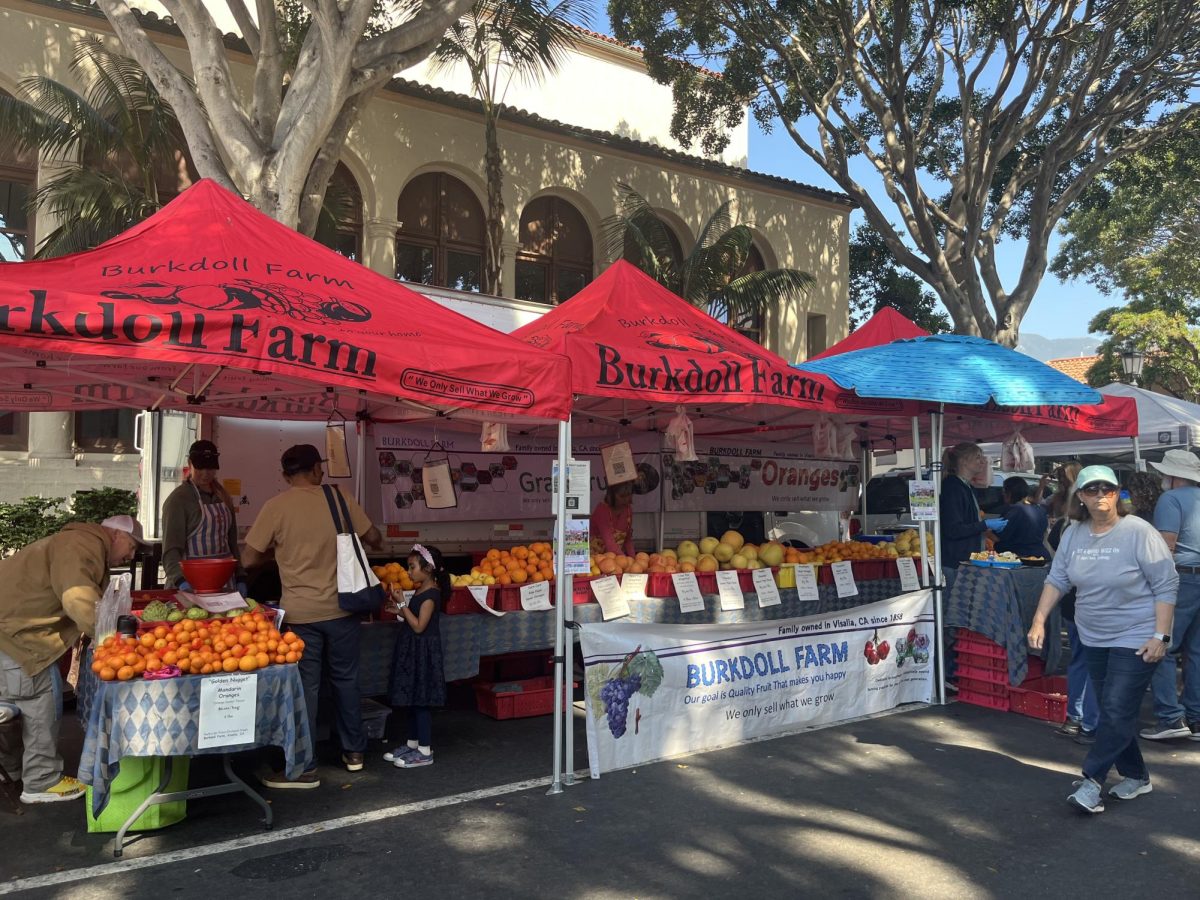
Every Saturday morning, Santa Barbara locals gather at the intersection of East Carrillo Street and State Street, leaving with bags full of fresh produce. Vendors line the streets with brightly-colored tents and tables heaped with fruits, vegetables, flowers, nuts, and honey. Everywhere, people chat and dance along to the sound of buskers.
Here, the Santa Barbara Farmers’ Market feels less like a place to shop and more like a place to belong.
“I feel it is like a local community which I have a connection to,” said Ilya Olyunin, who works at the Vista del Mundo table.
Olyunin sells avocados, lemons, and limes. The company was first founded when Santa Barbara was still a part of Spanish territory, and the land was divided into 200-acre lots.
“We have a variety of things,” Olyunin said. “I just want people to enjoy it together.”
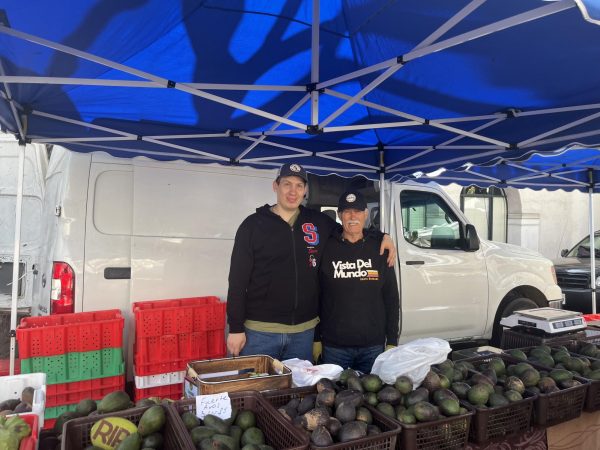
Despite being known to regulars as “the avocado guy,” Olyunin spends most of his week working as a software engineer. He describes juggling his job at the farmers’ market and his regular, day-to-day job as “a good balance.”
Vista del Mundo can only be found at the downtown Saturday market, but Olyunin said that he enjoys the experience there.
“Santa Barbara is kind of a bigger market. It’s more interesting,” Olyunin said. “I used to do some other markets before, and it was smaller and different, but this one, I feel attached attention for many groups.”
According to Olyunin, one of his favorite parts of the farmer’s market is the satisfaction of being able to provide for the community.
“I’m glad we can provide some good fruits for a lot of people,” Olyunin said.
That same sense of purpose and pride carries over to other companies across the market, such as Burkdoll Farms, where a decade-long journey into farming began almost by accident.
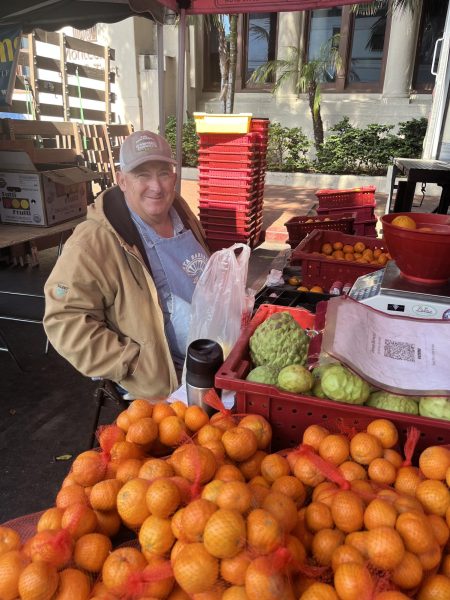
After spending nine years working in refugee camps in Thailand, James Burkdoll returned to America in 1991, intending to become a teacher so he could work in Thailand during the summer. However, Burkdoll said his grandmother requested him to farm the 70 acres of land, which had been in the family since 1858.
“I didn’t really want to do all that work because it was a lot of work,” Burkdoll said. “But anyway, I took a couple of classes and changed my major from liberal arts education to plant science, crop science — agriculture.”
Burkdoll moved on from College of the Sequoias to California State University, Fresno, where he got his Bachelor’s and Master’s degrees in plant science with an emphasis in viticulture and tree fruit.
Then, Burkdoll said he began working for an economic opportunities commission of Fresno County with the Indo-Chinese refugee population who were farming. A couple of jobs later, Burkdoll started planting crops on 50 acres of the land he had.
“My mom and my sisters and my mom’s sisters — they wanted to sell [the land],” Burkdoll said. “[They] saw no value in keeping the land.”
Burkdoll began planting grapes, cherries, peaches, and nectarines, which he sold in the front of his estate.
Soon, with that system in place, Burkdoll had “too much to sell in front of the house,” which led him to start selling at local farmers’ markets.
Around 1997, Burkdoll’s friend asked him to deliver fruit to his daughter, who was attending California Polytechnic State University at the time. It was then that he was exposed to Santa Barbara.
“I came over here, started doing Saturday market, drove over, and drove back in the same day,” Burkdoll said. “And then I expanded to Sunday. Tana Howard-Schillinger came along and started helping me [in] about 2005 or 2006.”
Burkdoll and Howard-Schillinger have since become beloved faces at the farmers’ market. Burkdoll says it is “fulfilling” to provide fresh fruit for his customers, which they wouldn’t have access to otherwise unless they grew themselves.
Burkdoll Farms is currently featuring oranges and grapefruits, but during the summer, their stand is busy with high demand for their stone fruit: peaches, nectarines, pluots, and apricots, as well as grapes and cherries.
Although his parents and maternal grandmother told their children never to sell the land, his sister and brother put up half the land for sale when their father passed in the early 2000s. Burkdoll resisted selling and was able to retain the other half of the land, which he continued to farm. Everything he grows is then sold at farmers’ markets.
Burkdoll Farms is currently featuring oranges and grapefruits, but during the summer, their stand is busy with high demand for their stone fruit: peaches, nectarines, pluots, and apricots, as well as grapes and cherries.
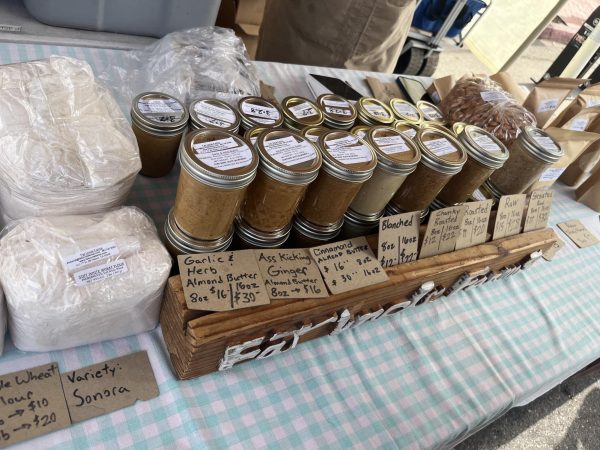
Just a few stalls away, Fat Uncle Farms, based in Wasco, California, and run by two brothers, Justin Siemens and Nate Siemens, offers almonds in nearly every form imaginable: whole, slivered, blanched, and ground into butter.
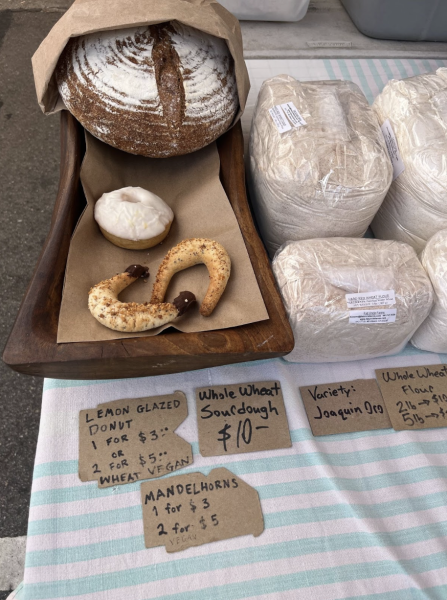
But their table doesn’t stop there. Fat Uncle Farms also stretches into selling various baked goods.
At their commercial kitchen, the Sonora and Joaquin Oro grain grown on their farm is milled and made into whole-wheat sourdough, whole-wheat vegan lemon-glazed doughnuts, and almond cookies made from almond flour.
Emiko Corey said the market represents something bigger than food.
“We have to work directly with our customers,” Corey said. “People here are using their money to live out their values — they are valuing small businesses, trying to support farmers, and keeping our money local.”
Corey has worked with the farm “on and off” for the last decade. Currently, she balances family life while working for Wilderness Youth Project, but also works at Fat Uncle Farms as a way to stay in contact with the farming community.
“I’ve known this farm for a long time, so I can come and help out,” Corey said. “So I can still participate in farming life, even if I’m not farming anymore.”
Over time, Corey has formed a deep connection to the farming community and the regulars at the farmers’ market.
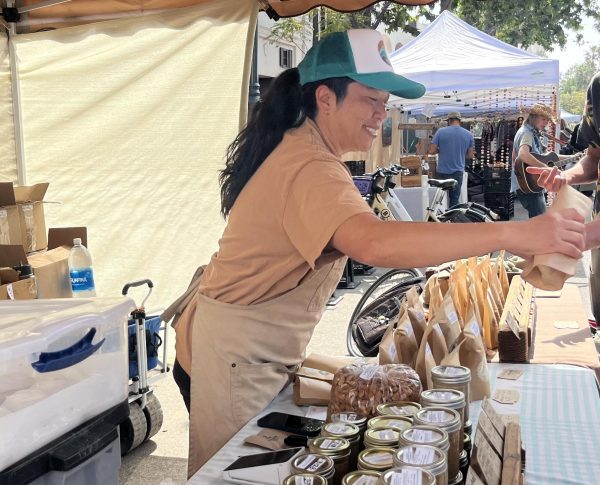
“I think it’s an amazing farmers’ market, and a lot of the people here are doing their best to feed our community, and I think that the community really appreciates what they’re doing there, so it’s a really great relationship,” Corey said.
Additionally, Domingo Farms is another stand that can be found at the Saturday farmers’ market. They sell vegetables, herbs, and cut flowers, and according to Rudy Domingo, the farm started with his father, a farmer from the Philippines who moved to Hawai’i before finally moving to California with his friends and family.
They continued to farm on a property in Arroyo Grande, California, and Domingo was born into the business as a second-generation farmer.
“Farming is always difficult, but I enjoy selling at the farmers’ market, because we sell to people who eat what we grow and appreciate what we do,” Domingo said. “And we make friends. It’s a social event, and you get good music, good people … a lot of the people that come here and shop — they’re not customers, they’re friends.”
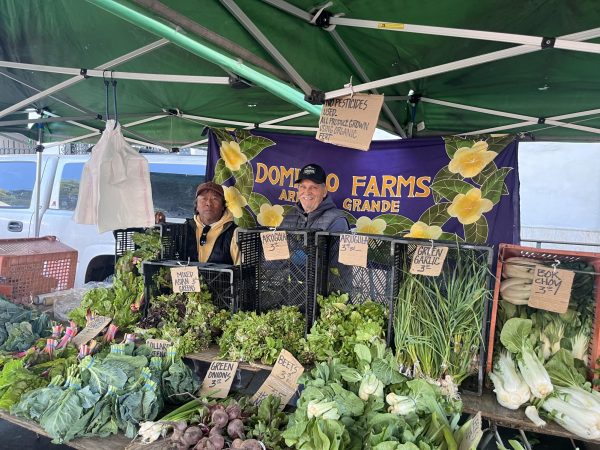
Domingo said he hopes that people who visit the farmers’ market realize that the work he does is important.
“I mean, if it wasn’t for me and all the other farmers, people would be hungry,” Domingo said. “They’d find something else to eat, but you would just not have the benefit of having good food and meeting the people that grow your food. And I think that’s the only way to keep farmers. If you want to see small farms out there, you just have to support farmers. That’s how it works.”
Roots Organic Farm can also be found at the farmers’ market. Founded by Jacob Grant out of fascination for the Earth and its products, the company started farming independently in 2002, selling lettuce, carrots, tomatoes, and melons.
“I get to constantly learn about what plants are on this planet and what water does to the world,” Grant said. “They’re all listening — the water’s listening, the plants are listening, we’re listening. You don’t have to have ears to listen. Everything’s listening, and it’s how everything is in relation to everything else.”
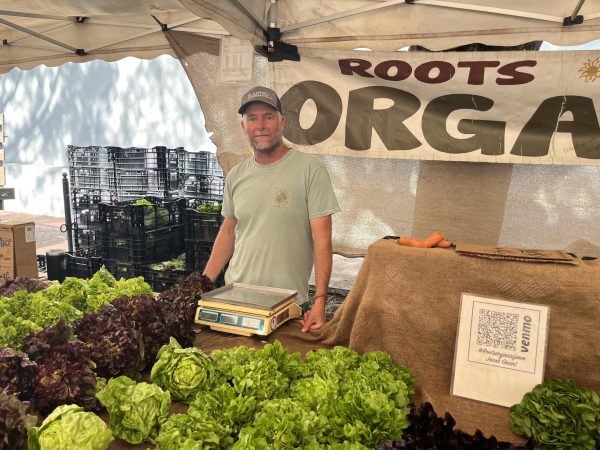
Grant’s path with agriculture commenced when he was in his late teens. He began volunteering in the summer at a family friend’s farm when he was 18 years old. From then, his fascination only grew, and soon he fully dedicated himself to learning from his mentor in what turned into a two-year-long apprenticeship program.
“I learned the basis of what I do, which is grow these vegetables in a very simple, kind of old, traditional method,” Grant said. “I don’t use any fertilizer or any pesticides, and I grow a big diversity of crops, and I bring it all to the farmers’ markets.”
Grant said his interest in farming stems from his perception of the vulnerability of society.
“I think that I was scared that society felt fragile,” Grant said. “And I felt like somehow growing food would give me some insulation from some fear of collapse.”
Grant feels a lot of gratitude towards the environment and towards the people he interacts with. He wants them to know that “the feeling is mutual,” and that the farmers’ market community exists within a positive feedback loop.
“I want them to know … that what I do is for them. And that my gratitude to everybody showing up here is not only a response to theirs, but it’s part of what keeps me motivated,” Grant said. “Part of what my motivation comes from is when I see people really excited about a particular lettuce. That feeds my inspiration to grow more of that kind of lettuce — to be able to have more of what people want.”
Combined, these farmers and their stories bring a sense of connection, community, and joy to the farmers’ market. For those who participate in it, what begins as a weekly errand run usually becomes something much more meaningful.
The Santa Barbara Farmers’ Market is open at the intersection of State Street and East Carrillo Street from 8 a.m. to 1 p.m. on Saturdays.
4/06/26 edited for grammar
5/05/26 edited for additional info