As the use of generative artificial intelligence (AI) becomes more prominent, teachers at Dos Pueblos High School find themselves at the front lines of a new academic battle. Concerned that AI tools could hinder the “critical thinking and authentic voices” of students, DPHS teachers are adjusting assignments and assessments to ensure that students continue to develop their own ideas.
“Cheating has been around forever, so it’s just a different form of that,” said Stephanie Henderson, an English 9 Ethnic Studies teacher. “AI can take away … not just from the content of English, but also the practice of thinking and revising and trying to have your own thoughts.”
Earlier in her career, Henderson utilized a program called Turnitin.com, which would check for plagiarism on student’s final drafts. Now, she says it is more difficult to determine if a student is submitting their original work.
“It’s hard to know if what they are submitting is their own thinking and there’s not really a website we can put things through,” Henderson said. “There is stuff that exists that’s like, ‘This sounds like it could be AI,’ but it’s kind of hard.”
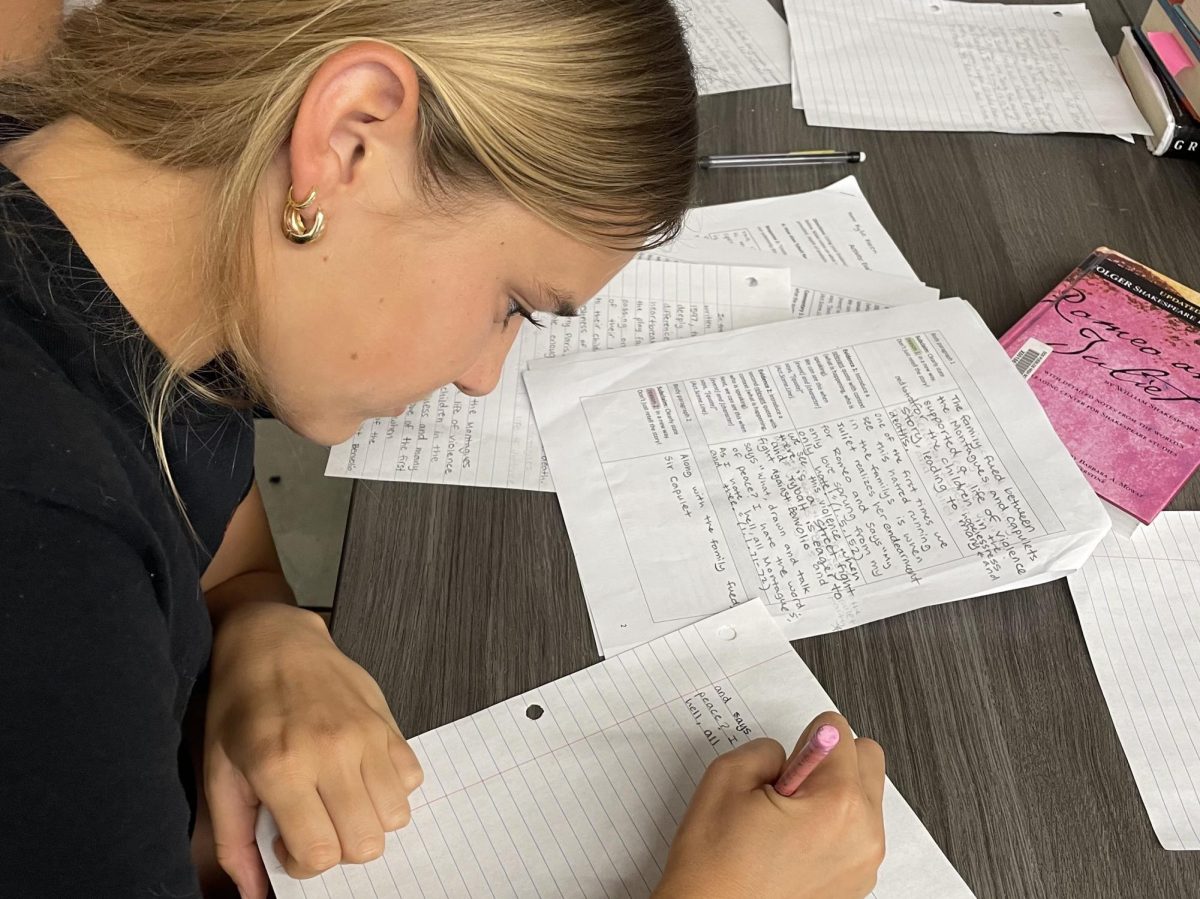
In response to this challenge, Henderson has moved towards completing more assignments in class.
“[We are] doing a lot more things on paper and in class rather than sending a lot home or having things digitally … [teachers] are modifying to use iPads less,” Henderson said.
Olivia Happel-Block, an English 1000 and 111 teacher, has taken a different approach to prevent the use of AI in her classroom, by changing how essays are completed.
“I’ve added in checkpoint assignments,” Happel-Block said. “[Students] have to get teacher approval on the thesis, I want to see topic sentences, I want to see your evidence … they have to show the process. You can’t go from nothing to a perfect essay, without showing your work.”
In addition to classroom changes, school policies have also had to address the use of AI in student work. Each teacher has their own AI policy, in addition to the DPHS Academic Integrity Policy, in which submitting work that was plagiarized to any extent is strictly prohibited.
“[AI] is under the plagiarism umbrella,” Henderson said. “Any thinking from somebody else, AI, or Google, or whatever. I really emphasize that I am looking for their thinking and their brain.”
Not only does AI pose concerns about academic integrity, but Happel-Block said that according to a 2025 study by Microsoft persistent use of AI can cause brain atrophy. Due to these concerns, Happel-Block limits where and when her students are permitted to use AI.
“In my classroom, there is really only one area where we allow students to use AI, and that’s in the research paper and the process for that,” Happel-Block said. “We allow students to use it to refine their research questions … and change the Lexile level [to match student competencies].”
While Henderson and Happel-Block are cautious about the use of AI in their classrooms, computer science teacher Ashley Ong has incorporated AI into their lesson plans.
“I think AI in education is something that is necessary, because AI is such a big thing that is in the current world,” Ong said. “Our job as educators is to prepare students for what they’re going to be doing in the workforce.”
According to Ong, incorporating AI lends itself better to certain subjects than others.
“My class is computer science, we have a new unit on AI literacy,” Ong said. “Specifically how to use AI, how does a AI like ChatGPT function, how do they make responses, and also how can you use it as a tool for your workflow.”
Ong said that while AI is a tool that students should learn to use, students should not use it for “creative tasks.” Muhammad Musab Zeb (10) agrees that AI can take away from students’ abilities.
“I think it kind of gets rid of creativity. Especially in humanities, if we’re using AI for critical thinking,” Zeb said.
However, Zeb also explained that AI can support learning when students use it thoughtfully.
“As long as you get something out of AI, on an assignment it’s not really cheating. But if you abuse it, just to get the assignment over with, that’s more [like] cheating,” Zeb said.
While students may see potential benefits, Happel-Block said that AI use has limited opportunities in English classes.
“I think that there are some places for it in the classroom in general, but in the English classroom I don’t think there is,” Happel-Block said. “Because English class is about building up the skills you need to read, to write, to think, to speak, to listen. What’s more important is the whole process of writing the essay to get to the final product.”
Additionally, Henderson said that AI can offer advantages, schools are still figuring out how to manage it responsibly.
“It can be such a helpful tool, but right now the negatives outweigh the benefits in terms of doing thinking for other people,” Henderson said.
To address concerns about AI and ensure that students continue to produce their own work, Happel-Block plans to make several changes to how essays are completed in her classes next year.
“At least one of our process essays, where students have time and they work outside of class, and they’re typing it up, it’s going to become an in class essay,” Happel-Block said. “That’ll just better help me be able to access that this is the student’s own work, and that these are their own ideas.”
While implementing these changes, Happel-Block faces some reluctance, as she sees essay writing as an essential skill for students.
“The essay has been something for centuries that teachers have used to assess student knowledge.” Happel-Block said. “So teachers are really having to pivot to finding what’s going to work, and what they can do in place of the essay.”
Despite the difficulties that AI has introduced, Happel-Block emphasizes the importance of guiding students to cultivate their own authentic voices.
“[It’s important to] urge students on their own, to return to their own voice, to see the importance of their voice, why their voice matters, and why developing their voice is something they should care about, and something they should want to do,” Happel-Block said.